

AI is already here and small business is bullish
76% of small businesses are already using AI. Only 14% have actually embedded it into how they work.
That gap isn't a technology problem. It's an implementation problem — and it's exactly where most companies are stuck right now.
A recent Goldman Sachs survey confirmed what I'm seeing on the ground: SMB adoption is high, results are positive (93% report a meaningful impact, 84% cite efficiency gains), and yet the majority are still using AI as a sidekick rather than a core part of how they operate. The bottleneck isn't enthusiasm. It's knowing what to do next.
The good news? The companies that have crossed that line aren't bigger or better-resourced. They just had the right support to make the leap.
What are these fast movers doing, and why are they ahead
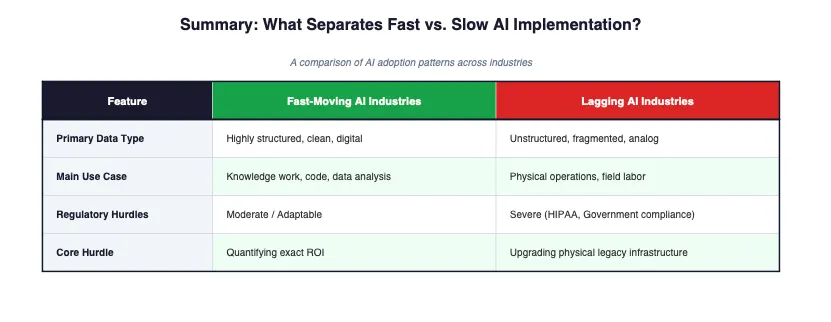
The divide between industries is dictated by two main things: data readiness (how digitized their records already are) and regulatory friction.
These industries are moving at breakneck speed because they possess high volumes of clean, digital data and have clear, highly quantifiable ROI metrics (e.g., time saved, risks mitigated).
- Technology & Software: The undisputed leader with enterprise adoption rates hovering around 78%. Tech companies are both building the models and embedding them into daily operations. AI coding assistants now write more than 40% of all software code.
- Financial Services & Insurance (BFSI): Driven by easily quantifiable returns. Banks and insurance firms have quickly scaled AI for real-time fraud detection, credit risk modeling, and automated algorithmic trading. McKinsey and industry reports show this sector commands the largest share of the global enterprise AI market.
- Professional & Legal Services: A surprise runaway leader. Because the legal and consulting fields are incredibly document-intensive, generative AI has been implemented at a blistering pace for automated contract analysis, discovery, and legal research, reducing document review timelines by 50% to 80%.
- Media, Marketing & Telecom: These data-heavy sectors have aggressively deployed AI for hyper-personalized consumer content recommendation, automated ad targeting, and generative video creation.
These industries are struggling to implement AI. While they may run small "pilot projects," scaling AI into full production stalls due to physical-world complexity, security concerns, or a total lack of structured data: Construction & Real Estate, Healthcare & Life Sciences, Education & Government Services, Traditional Retail.
So how do you find out which camp your competitors are in? This is where Perplexity earns its place.
The tool
Perplexity for market research. Perplexity is the thing you actually open when you need to understand a competitor's positioning or scan an industry fast. People use it for market research because it acts as an intelligent, conversational research assistant. It saves time by autonomously reading across hundreds of web sources to synthesize direct answers, rather than forcing you to sift through endless links. Every claim is backed by inline citations, allowing you to instantly verify the real time data. I used it to prep for a client pitch in 20 minutes instead of 2 hours.
The move
Your concrete do-it-this-week action: Open Perplexity and run these two prompts on your own industry. It takes 30 minutes and you'll walk away with a clearer picture of where your competitors stand than most people get from hours of Googling.
"Give me a detailed overview of the main competitors in [your industry] in [geography]. For each, summarize their core product or service offering, key messaging, and any notable recent activity such as product launches, campaigns, or press coverage."
and
"What are the main needs, frustrations, and priorities of [target audience] when it comes to [product or service category] in [geography]? Draw from public discussions, reviews, and any available research."
From the field
The pattern I'm seeing exactly matches the Goldman Sachs surveys, that most companies are using AI already in some form, mostly working alongside their employees. But the step to actually start embedding it into core workflows is where it is harder to implement. The ones that are taking that step are not necessarily the ones who know more about AI. It's the ones that are not afraid to learn.
Frequently asked questions
What's the gap between AI adoption and AI implementation? 76% of small businesses are already using AI, but only 14% have actually embedded it into how they work — the bottleneck isn't enthusiasm, it's knowing what to do next.
Which industries are moving fastest on AI, and why? Technology & Software, Financial Services & Insurance, Professional & Legal Services, and Media/Marketing/Telecom — because they combine high volumes of clean digital data with clear, quantifiable ROI metrics.
Which industries are struggling to implement AI? Construction & Real Estate, Healthcare & Life Sciences, Education & Government Services, and Traditional Retail — they run small pilots but stall scaling into production due to physical-world complexity, security concerns, or a lack of structured data.
How can I quickly find out where my industry or competitors stand on AI adoption? Run a Perplexity market-research query on your own industry — it takes about 30 minutes and gives a clearer competitive picture than hours of Googling.